About
How does it work?



Who is the Fruit Tree Guy?
Hi, I’m Mark and I started The Fruit Tree Guy in 2025 after planting a couple of fruit tree I bought from a big-box store and having them promptly die (despite giving them proper care). Nothing in my decade of experience with fruit trees or the dozens of books I’ve read on growing fruit led me to believe there was a reason these trees should have died other than not being healthy when I purchased them. I had previously been most successful with trees I purchased from The Apple Tree Guy in Carlton since he sold top-quality, bare-root fruit trees and stored them properly so the roots wouldn’t dry out. As I was kicking myself for not buying from him again I saw a note on his website that he was no longer selling trees. I wanted to replicate the success I had growing trees I bought from him and wanted to share that success with others, so I gave him a call and talked business. I decided to start The Fruit Tree Guy, selling fruit trees in a way that leads to the best chance for successful growing, just like he had done. I want to help you grow fruit trees successfully just like he helped me to.

What are Bare-Root Trees?
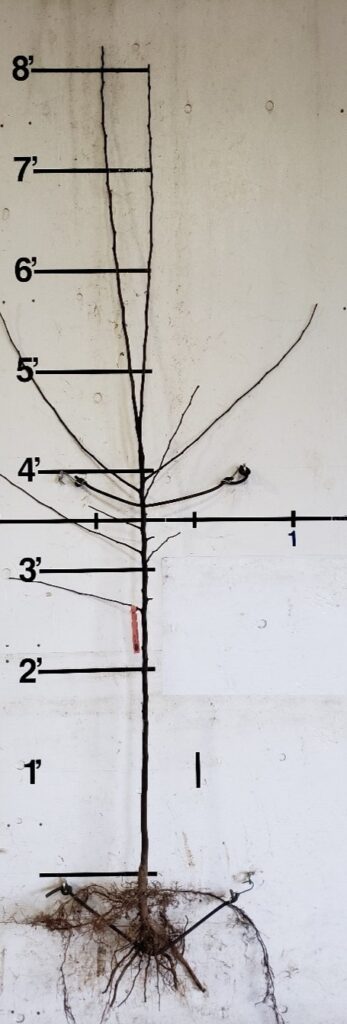
A bare-root fruit tree is just what it sounds like, a tree with it’s roots not covered. While a tree is actively growing this would be a bad thing, but while trees are dormant, they tolerate this very well. Bare-root is one of three ways trees are sold with the other two being potted and ball-and-burlap. While bare-root trees should be dormant, the other two can be growing, however transplanting trees while they are dormant is best to avoid transplant shock and other stress to the trees.
Bare-root trees come with several advantages.
1. Superior Root Health
The most critical part of a fruit tree is the part you can’t see.
- No Pot-Bound Problems: Potted trees often grow in circles, becoming root-bound and strangling themselves over time. Bare root trees grow naturally and freely.
- Instant Soil Adaptation: A potted tree has to transition from perfect, fluffy potting mix to your native garden soil, which often causes “transplant shock.” A bare root tree is planted directly into your native soil, allowing it to adapt immediately and establish a more resilient root system.
- More Root Mass: Research by the university of Massachusetts shows bare root trees can have up to 200% more root mass than a similarly sized potted tree. This can either be from less vigorous root growth while in a pot, or from trees being shipped to garden centers as bare-root and roots needing to be trimmed to fit into pots.
2. Faster, Stronger Growth
It seems counterintuitive, but the dead-looking stick will often overtake the potted tree within 2–3 years.
- Because they are planted during dormancy (winter/early spring), bare root trees wake up in your garden. They channel 100% of their spring energy into root establishment rather than keeping existing leaves alive.
- The result is a tree that is more vigorous, drought-tolerant, and productive in the long run and are much less likely to experience transplant shock.
3. Unbeatable Variety
Garden centers only have space for the greatest hits and big-box stores often have the same varieties all over the country.
- Bare root nurseries take up less space, allowing them to stock many unique varieties—heirloom apples, specific stone fruits, and rare cultivars you will never find in a big-box store.
- If you want a specific flavor profile or a tree perfectly suited to your microclimate, bare root is the only way to go.
4. Cost & Eco-Friendly
The Planet: They ship lightweight (low carbon footprint) and eliminate the need for black plastic nursery pots that end up in landfills.
Your Wallet: Without the cost of heavy soil, plastic pots, and nursery maintenance, bare root trees are often 30–50% cheaper than potted alternatives of the same size and quality.
Why would you pay more for a plastic pot you don’t need only to get a tree with less roots?
Contact
Phone: 218-451-3222
email: mark@fruittreeguy.com
Tree Pickup Warehouse: 701 Laurel Street, Cloquet, MN 55720
Frequently Asked Questions
Intro Text Block
Why bare-root?
There are several reasons to prefer bare-root trees:
- Potted trees often have their roots pruned to fit in to pots meaning your tree has less roots to absorb water and nutrients and will have a harder time getting established.
- If a tree is in a pot too long its roots will start to spiral around the outside of the pot (becoming root-bound), when planted in the ground this spiral can continue and and cut off circulation from the roots (this is known as girdling).
- Because of lower material and labor costs bare-root trees can be sold at lower prices.
- Plastic waste is reduced by not needed a pot, which is generally plastic.
Can you identify what fruit tree I have?
It’s generally impossible to identify cultivars only by visual inspection. For apple trees there is DNA testing available from My Fruit Tree at a cost of $50.
Will my tree’s fit in my car or truck, or do I need a trailer?
Trees will not fit in the trunk of a car, if you don’t mind getting your car dirty and you’re careful you could fit two or three across the passenger and back seats of a car, but a minivan or truck are better. A minivan will fit 12 or so trees and a pickup truck even more (it’s okay if they stick out the back of a short-box). A trailer isn’t necessary unless you’re pulling it with a car or you have a lot of trees.
How do I know my USDA Hardiness Zone?
USDA Hardiness Zones are based on the coldest temperature that is reached in any location. The USDA periodically updates these zones based on average data over 30 or more years. You can check your location on their map here: https://planthardiness.ars.usda.gov/
How long do I have to plant the tree once I pick it up?
It’s best to plant them as soon as you can to prevent the roots from drying out, but you can wait up to a week if you keep them moist. Don’t leave the roots exposed to air or sunlight before planting.
Where are you located?
Our warehouse is right in Cloquet at 701 Laurel Street. We are only open by appointment or on tree pickup weekends.
How far apart should I plant my fruit trees?
This depends on size, but generally 16-20 feet for semi-dwarf, 24+ feet for standard and 6-12 feet for dwarf varieties. If you have lots of space further is okay, but more than 50 feet reduces the chances of good pollination.
What if my question isn’t answered here?
You can contact us with your questions.